About the Atomic Structure Lab simulation
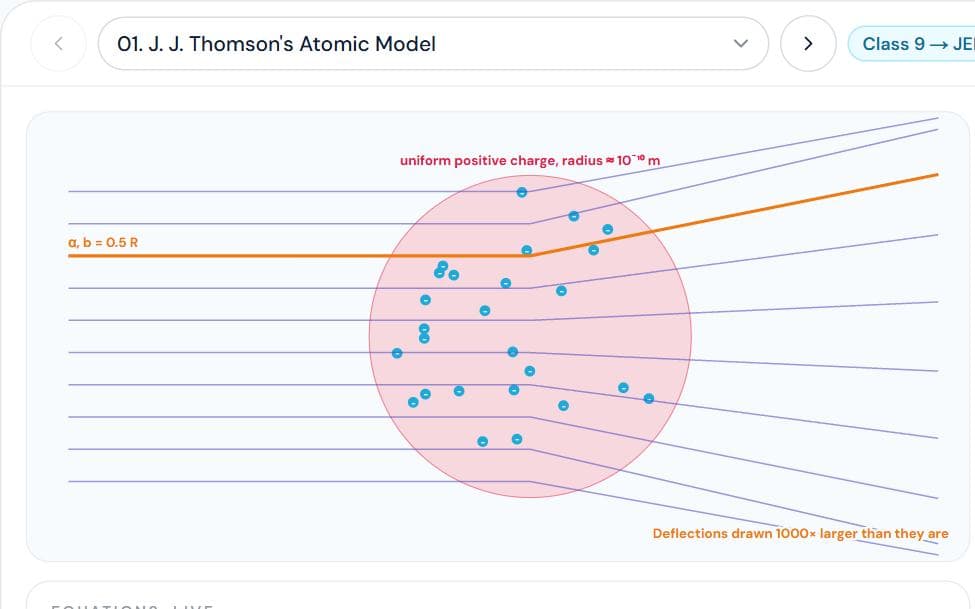
Structure of Atom is the first chapter of Class 11 chemistry and one of the most numerical in JEE and NEET. This lab puts the whole of it on one page, in the order it is taught: fire α-particles through Thomson's plum-pudding atom and through Rutherford's nucleus, balance a cathode-ray beam between electric and magnetic fields to find e/m, bend canal rays of six gases, and watch a classical electron spiral into its nucleus in 10⁻¹¹ s.
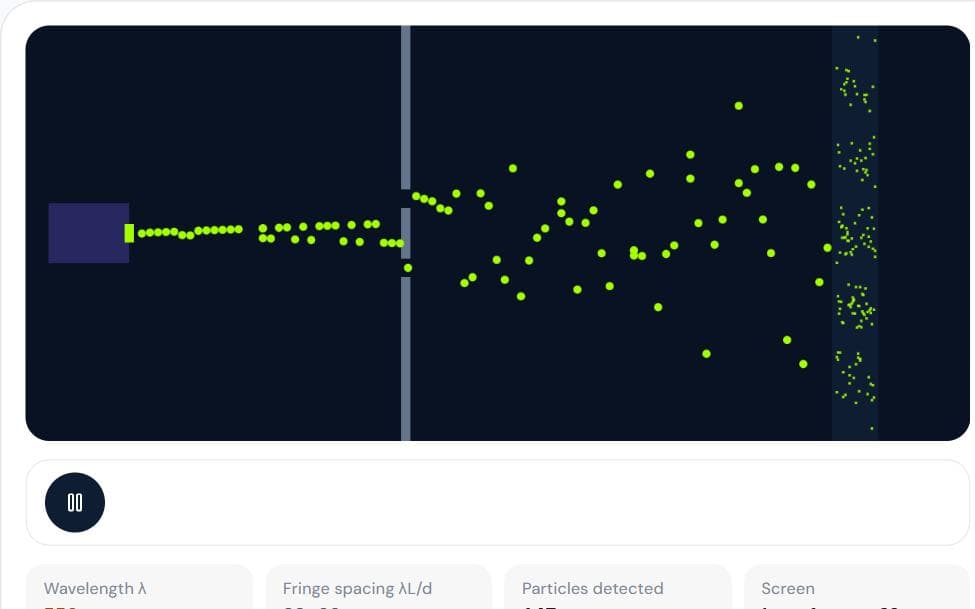
Then the quantum half: c = νλ and the electromagnetic spectrum, Planck's quanta, the photoelectric effect with real work functions and stopping potentials, Bohr's orbits with their radius, speed and energy for H, He⁺, Li²⁺ and Be³⁺, the hydrogen spectrum and its five series, de Broglie waves and electron diffraction, and hydrogen's orbitals drawn from their actual wavefunctions — shapes of s, p and d orbitals, nodal planes, radial nodes and the radial probability curve.
Each of the thirty-one modules has a prediction question, a derivation, concept questions with hints (single, multiple-correct, assertion–reason, numeric and explain-in-words) and fresh practice numericals every time you ask.
Also covers: structure of atom, atomic structure, thomson model, plum pudding model, rutherford model, gold foil experiment, alpha particle scattering, distance of closest approach, cathode ray experiment, e/m of electron, anode rays, canal rays, limitations of rutherford model, electromagnetic radiation, frequency wavelength, c = νλ, wavenumber, electromagnetic spectrum, planck's quantum theory, energy of photon, photoelectric effect, threshold frequency, work function, stopping potential, einstein photoelectric equation, bohr model, bohr's postulates, radius of bohr orbit, energy of electron in nth orbit, velocity of electron, hydrogen spectrum, emission and absorption spectrum, lyman balmer paschen brackett pfund, rydberg formula, number of spectral lines, de broglie wavelength, dual nature of matter, davisson germer, 2πr = nλ, orbit vs orbital, quantum numbers, shapes of orbitals, s p d orbitals, px py pz, nodal plane, radial nodes, angular nodes, radial probability distribution.