About the Fluid Mechanics Lab simulation
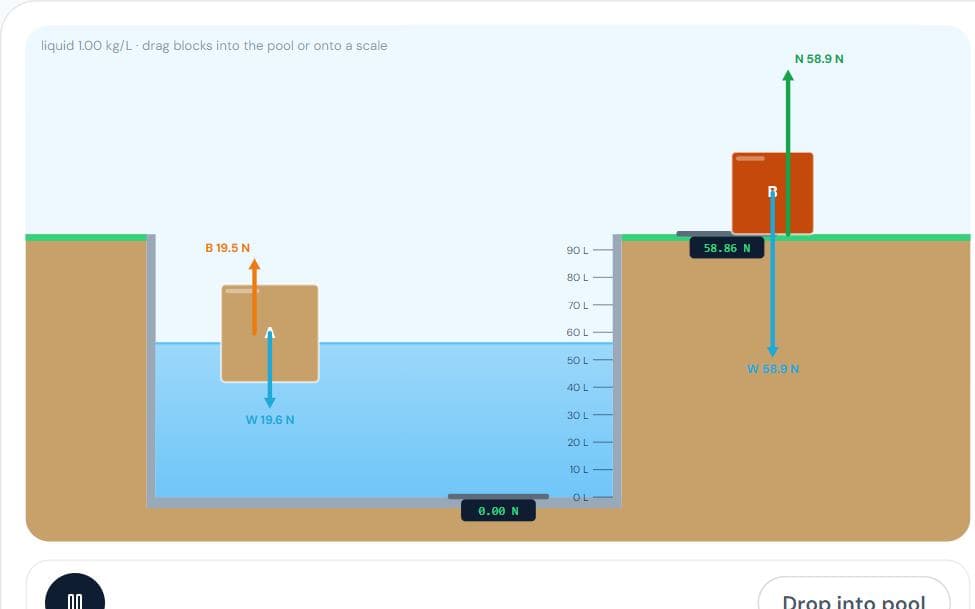
Fluid mechanics is the chapter where students most often memorise formulas without knowing when they apply. This lab puts every idea on a stage you can change: drag a pressure sensor through layered liquids, push a hydraulic piston, tilt a dam gate, lower a block into an overflow can, pull a wire through a soap film, narrow a pipe, punch holes in a tank, turn an aerofoil in a computed airflow, drop spheres through glycerine and honey, and pump water through rough pipes and valves.
The twenty-five experiments run in five levels — hydrostatics; buoyancy and surface tension; flow and Bernoulli; viscosity and real fluids; and applications with a JEE Advanced challenge builder. Each states its model's assumptions, warns when they break (Stokes' law above Re ≈ 1, Poiseuille in turbulent flow, Bernoulli across a pump), and carries prediction questions, derivations, concept questions with hints and "Show me", and seeded practice numericals.
Also covers: fluid mechanics, mechanical properties of fluids, density, relative density, pressure, hydrostatic pressure, gauge pressure, absolute pressure, hydrostatic paradox, communicating vessels, pascal's law, hydraulic lift, barometer, manometer, centre of pressure, archimedes principle, apparent weight, floating and sinking, buoyancy, surface tension, soap bubble, excess pressure, capillary rise, jurin's law, streamline flow, equation of continuity, bernoulli's theorem, venturi meter, torricelli's law, velocity of efflux, lift on aerofoil, viscosity, stokes law, terminal velocity, poiseuille's law, reynolds number, laminar and turbulent flow, drag coefficient, head loss, pump head.