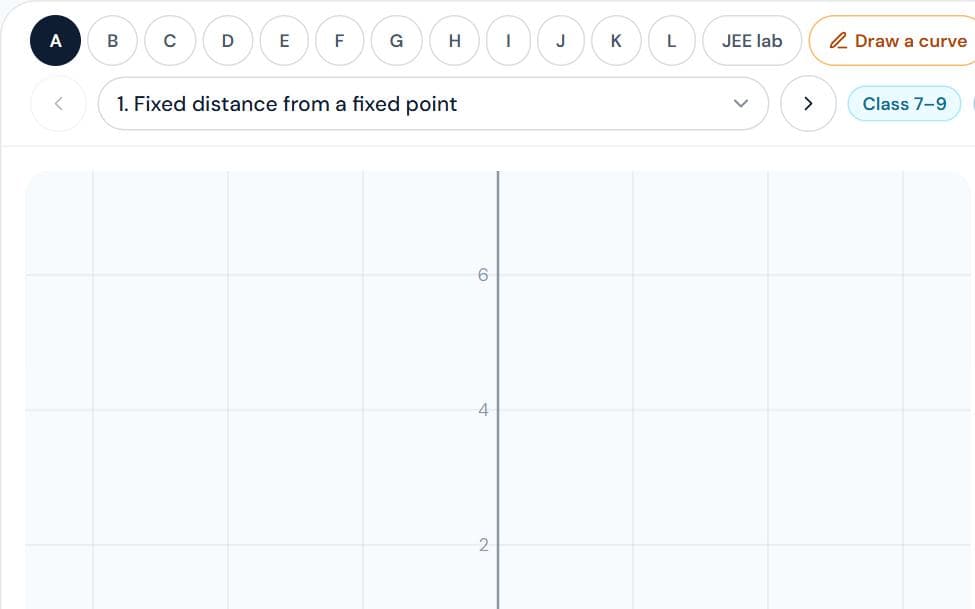
About the Locus Lab simulation
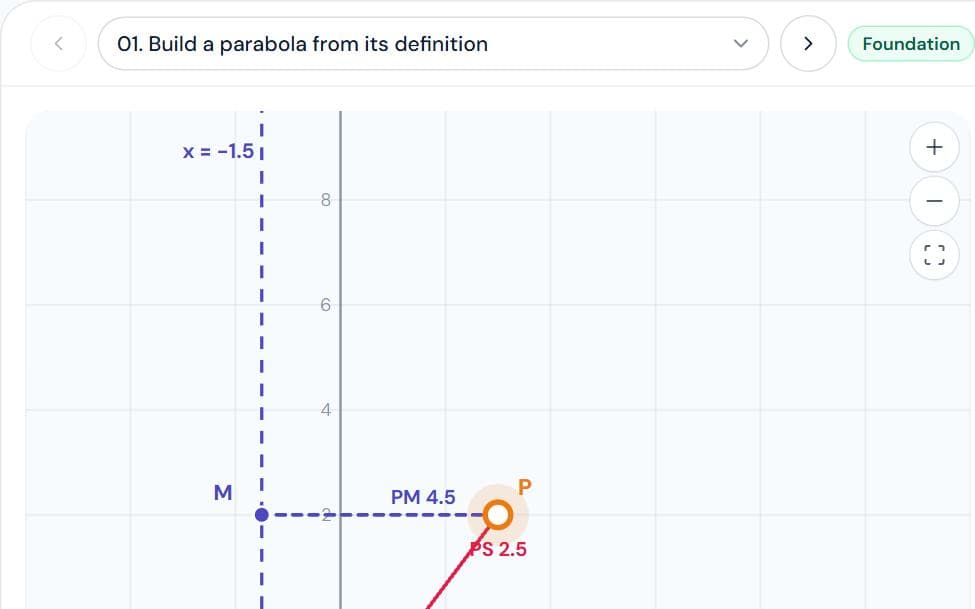
A locus is the set of every position a point can take while it obeys a condition — stay 3 cm from a point, stay as far from a point as from a line, keep the angle at the vertex fixed. This lab turns each condition into a simulation: drag the fixed points, press play, and watch the moving point trace its path, built step by step from the condition itself. Then switch on the exact locus, computed separately, and see the two agree; a live check shows the condition holding at the moving point.
The 137 experiments are arranged in twelve families and a JEE Advanced problem lab: basic loci (Classes 7–9), moving points and triangle centres, circle geometry, conics, algebraic equations, rolling curves and linkages, transformations, distance–angle–ratio conditions, envelopes and evolutes, 3D surfaces, complex-number loci on the Argand plane, and polar curves. Every answer is classified — a curve, a region, a finite set of points, the empty set, a degenerate locus or a surface — because not every locus is a curve. Each experiment has a prediction question, a step-by-step derivation, common mistakes, practice problems and a challenge; a ‘draw a curve’ tool fits your own sketch and suggests which condition could produce it.
Also covers: locus, loci, locus of a point, perpendicular bisector, angle bisector, locus of midpoint, locus of centroid, locus of orthocentre, locus of circumcentre, locus of incentre, apollonius circle, director circle, chord of contact, focus directrix, eccentricity, cycloid, epicycloid, hypocycloid, cardioid, limacon, rose curve, spiral, lemniscate, envelope, evolute, pedal curve, simson line, complex numbers locus, argand plane, arg z, locus in 3d, sphere cone cylinder, jee locus problems, eliminate the parameter.